
What is a decentralized exchange or DEX?
A decentralized exchange is a blockchain-based platform that enables buying and selling cryptocurrencies. It is a smart contract. Smart contracts impacted many traditional centralized industries, and centralized exchanges were one of them.
The best way to understand the concept of DEX is by comparing it with a centralized exchange. For this reason, we will go through the differences between a centralized and a decentralized exchange in the following part.
The differences between a centralized exchange and a decentralized exchange
If you are a crypto fan or user, you have used a centralized cryptocurrency exchange. A centralized cryptocurrency exchange is an online website from which you can buy different cryptocurrencies. You can also sell your cryptocurrencies to these cryptocurrency exchanges. They usually have a single manager or a managing team.
To use a centralized crypto exchange, you must first register. The registration process is different in different cryptocurrency exchanges. Some centralized exchanges let you register with an email address, and others require passing KYC. Even if you are allowed to register with an email address, you usually have a withdrawal limit. If you want to pass that limit, you have to pass KYC.
Cryptocurrencies came to remove third parties and fight with centralization. Although centralized cryptocurrency exchanges are fast, user-friendly, and have high liquidity, they are still centralized. This centralization and the need for passing KYC bother some crypto users. Centralized cryptocurrency exchanges aren’t in line with the initial ethics of cryptocurrencies.
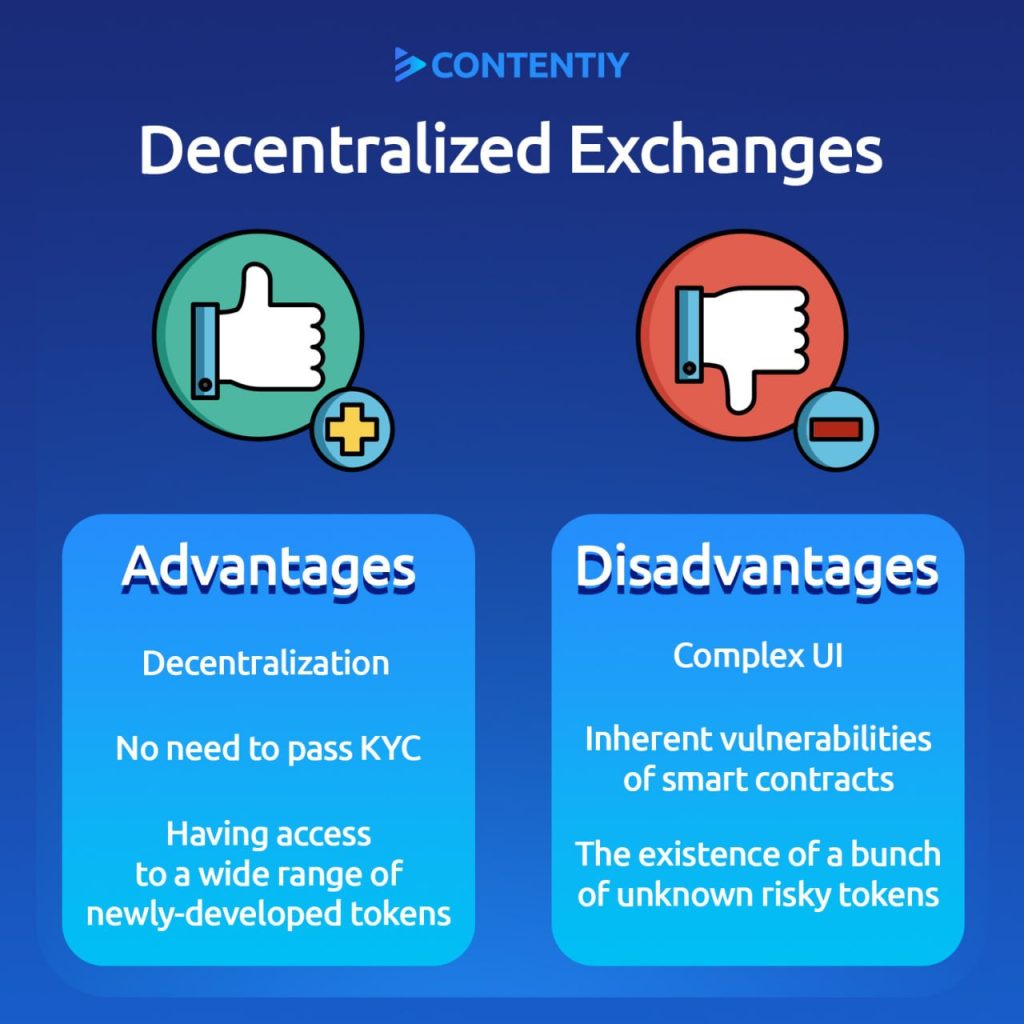
Decentralized exchanges are the opposite points of centralized ones. To use a decentralized exchange, you only need a web three wallet like MetaMask. The exchange connects to your wallet and trades from within your wallet. There is no need for registration and KYC.
| Centralized Exchange | Decentralized Exchange or DEX |
| A website with a single manager or a managing team that has a high level of liquidity and allows buying, selling, and trading cryptocurrencies. Using a centralized exchange requires registration, either with a simple email address or with passing KYC (Know Your Customer). | A smart contract on any blockchain like Ethereum and Solana that supports smart contracts and decentralized applications. All users govern a decentralized exchange, and its liquidity is provided by its users. Using a decentralized exchange doesn’t require registration. It only needs a web 3.0 wallet like MetaMask that gets connected to the exchange. |
You may now wonder where a decentralized exchange takes its liquidity from. Stay with us in the next part to figure out how decentralized exchanges work.
How does a decentralized exchange or DEX work?
Most DEXs we have today are automated market makers (AMM). Automated market makers consist of liquidity pools. Each liquidity pool also consists of different trading pairs. A trading pair refers to two cryptocurrencies that can be changed from each other. For example, BTC/ETH is a trading pair.
In automated market makers, users provide the liquidity of different trading pairs. For example, if they choose the BTC/ETH trading pair, they have to provide the liquidity of both of these cryptocurrencies. This means they give a part of their bitcoins and a part of their ethers to the exchange.
You may now ask why a user should give their cryptocurrencies to an exchange. The answer is that they receive a part of the fees as their reward. You know that each trade has a fee that the trader pays. An amount of this fee in DEXs goes to the user who had provided the liquidity of this trading pair.
Liquidizing DEXs is known as liquidity mining, which is an appropriate solution for users with passive cryptocurrencies. Instead of holding their cryptocurrencies in their wallets, they can monetize them through liquidity mining.
Disadvantages of decentralized exchanges
We mainly talked about decentralized exchanges’ advantages, but they aren’t flawless. We will go through several disadvantages of decentralized exchanges in the following parts.
Complex UI
As we previously mentioned, centralized exchanges are user-friendly and easy to use. Decentralized exchanges have a more complex UI in comparison with centralized exchanges. Working with decentralized exchanges may seem a bit difficult for beginners.
Vulnerabilities of smart contracts
Another problem of decentralized exchanges is the inherent vulnerability of smart contracts. Smart contracts are codes on the blockchain. Even the most tested and trialed codes can have security breaches. If a security breach is found in a DEX, hackers can attack it, and users’ assets will be lost.
Risky tokens
The last problem we would like to refer to is the existence of risky tokens. Unlike centralized exchanges, listing a token on a DEX is very easy. This leads to a great bunch of new unknown tokens in decentralized exchanges. Investing in new anonymous tokens is a good strategy for making profits, but it doesn’t always work. Before investing in any token or project, we suggest you spend enough time researching. Read the token’s whitepaper, search about its team and developers, think about its aim and goals, and decide whether to invest in it.
The best-decentralized exchanges by TVL and trading volume
As the final part of the article, we’d like to refer to several well-known decentralized exchanges we have today. These exchanges have the highest Total Value Locked (TVL) and trading volumes among the existing options:
- Uniswap
- Curve
- PancakeSwap
- Balancer
- DODO
- SushiSwap
- Quickswap
- Orca
- Trader Joe
Conclusion
In this article, we tried to explain a decentralized exchange or DEX and how it works in the simplest terms. Centralized and decentralized exchanges differ in many ways, but the essential difference lies in centralization. Since a decentralized exchange doesn’t require registration and passing KYC, it’s more in line with the ethics of cryptocurrencies. However, it’s undeniable that centralized exchanges are more user-friendly and have more liquidity. Therefore, they are more appropriate for newcomers. Which one do you prefer, a decentralized exchange or a centralized one?
What is a decentralized exchange?
A decentralized exchange (DEX) is a platform that allows peer-to-peer cryptocurrency trading without relying on a central authority to hold users’ funds.
How does a DEX work?
A DEX uses smart contracts to enable peer-to-peer trading between cryptocurrency users. Buyers and sellers can interact directly with each other, and trades are executed through the use of blockchain technology.
What are the advantages of using a DEX?
Some advantages of using a DEX include greater security, as funds remain in the control of users, as well as increased privacy, transparency, and censorship resistance.
What are the challenges of using a DEX?
Some challenges of using a DEX include potentially lower liquidity and higher trading fees compared to centralized exchanges. In addition, the user interface and experience can be more complex for beginners.
How do I use a DEX?
To use a DEX, users typically need to connect their cryptocurrency wallet to the platform and then select the cryptocurrency they wish to trade. They can then browse open orders and select a trade to execute.
What are some examples of DEX?
Some examples of DEXs include Uniswap, PancakeSwap, and SushiSwap.